Implementing a trans-EUROpean PEPper LANDrace collection for resilient agriculture
Activity Coordinator: Pasquale Tripodi
The EUROPEPLAND Activity, submitted by the Solanaceae Working Group for funding under the First Call of the Phase XI ECPGR Activity Grant Scheme, was selected by the Executive Committee and approved in March 2024.
- Activity proposal (895,8 KB)
Project summary
The Mediterranean basin is a centre of secondary diversification for pepper, harbouring highly diverse landraces that are vital for resilient agriculture. These genetic resources represent a reservoir of traits adaptable to diverse environments and hold significant potential for breeding new varieties. However, their full exploitation is often hindered by incomplete passport data and insufficient characterization. EuroPepLand addresses these gaps by improving both phenotypic descriptors and genomic characterization of Capsicum landraces held in European genebanks and research institutions, making this information available through AEGIS, the EVA Pepper Network and EURISCO.
The project brings together 19 partners from 13 countries – Armenia, Bulgaria, Czech Republic, France, Germany, Greece, Italy, Netherlands, North Macedonia, Portugal, Romania, Serbia and Spain – ensuring broad continental coverage. Partners include major genebanks such as INRAE, INIAV, CGN, IPK, CNR and COMAV-UPV, alongside institutions with specialist expertise in genomics, bioinformatics and stress physiology.
The core activity is the development of a novel core collection of approximately 300 accessions representing the full diversity of European pepper landraces, with a focus on domesticated Capsicum annuum. Work is organized across three tasks:
- Task 1 establishes the core collection based on geographic origin and key fruit traits, with seed regeneration and safety duplication across partner genebanks.
- Task 2 applies common phenotyping protocols aligned with the EVA Pepper Network, alongside next-generation sequencing using the existing 19K pepper array – enabling data integration across both collections. Selected genotypes will also be assessed for bioactive compounds and salt stress tolerance.
- Task 3 integrates genomic, passport and phenotypic data to investigate genetic diversity, population structure and candidate genes. A small subset of accessions will undergo proof-of-concept abiotic stress and metabolic trials.
All data will be linked to DOIs and deposited in EURISCO, Zenodo and the EVA tools, maximizing the long-term accessibility and valorization of European pepper genetic resources for sustainable breeding.
Implementation
March 2026
The EuroPepLand annual meeting was held online on 26 March 2026. During the meeting, updates were provided on the Meeting of the Working Group Chairs held in Spain in early March, and the project's progress was illustrated. The final EuroPepLand collection consists of 397 accessions, plus an additional 44 recovered from the EVA Pepper project, bringing the total to 441 accessions. The collection covers all relevant European pepper production areas and thus has broad geographic coverage. The discussion focused on genomic data analysis to infer the population structure and phylogenetic relationships among the studied accessions. Based on approximately 7,000 high-quality SNPs, it was possible to distinguish accessions by origin, identifying two diversity hotspots in Southern Europe and the Balkans. This reflects diversification within secondary centres of diversity and highlights the value of this collection as a resource for further exploitation by the EVA Pepper Network. Results from pilot experiments phenotyping for salt stress, conducted through spectral and metabolomic analyses, were also presented, showing promising results.
January 2026
Genotyping of the EuroPepLand collection, consisting of 397 European landrace accessions, was finalized. A genotyping matrix was obtained, consisting of 9,928 SNP markers yielding 149,272 polymorphic sites. A phenotyping experiment for salt stress tolerance was carried out on 11 pepper genotypes. The next step will be the analysis of the genotyping data to determine genetic diversity and phylogenetic relationships.
October 2025
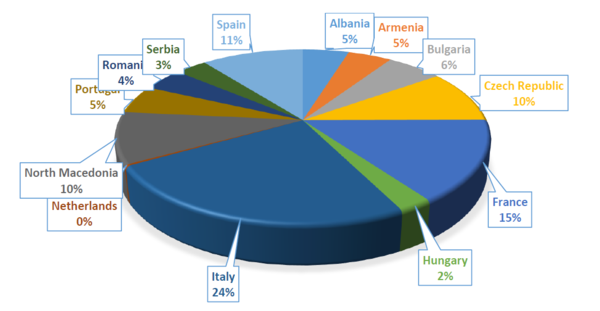
In the past few months, the nucleic acid isolation from plant samples has been completed. High-quality DNA was obtained from 400 accessions representing the EuroPepLand collection. Thirty out of the 430 accessions provided by partners did not germinate. This does not constitute a limitation, as it does not impact the diversity of the collection. All partners are adequately represented, displaying an appropriate balance among the various European geographical regions. The first batch of samples was sent in July, and data were delivered in September. So far, 372 accessions have already been genotyped, yielding over 9,900 SNPs. The last plate is currently ongoing, and results are expected before the end of the year. Data will be analyzed once the entire SNP dataset is finalized. Most partners provided the phenotyping data for the accessions they contributed. Information available for the collection beyond passport data includes shape, colour, pungency and fruit size data.
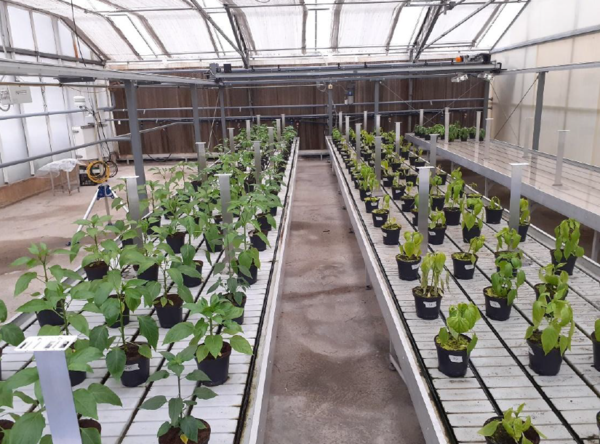
In November, a phenotyping experiment for salt stress will be carried out on selected accessions in order to confirm previous data on materials from the EVA pepper project and some accessions part of the EuroPepLand collection. The experiment will be performed in the phenotyping platform of CREA-OF https://shorturl.at/cKeeD. Leaf samples from the control and salt stress trial will be analyzed for metabolite content in 2026.
May 2025
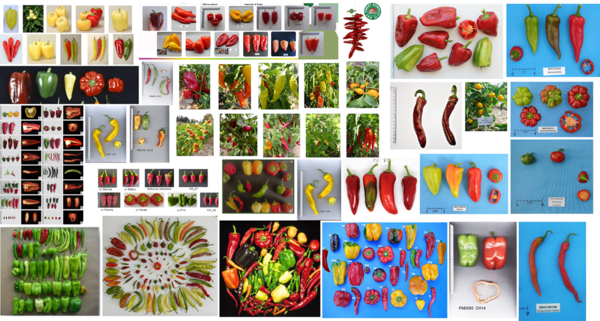
During a virtual meeting on 14 May 2025, project partners were updated on progress in the processing of pepper samples for genotyping. The current collection encompasses more than 400 landraces from 12 collections with a balanced geographical representation from across Europe, a secondary center of pepper diversification. The project is making good progress with all partners contributing material and expertise. As DNA extraction and genotyping will proceed in the coming months, phenotypic data for priority traits will be collected from historic sources or field trials conducted in 2025 to allow genomic association analyses and for sharing in EURISCO. A next meeting will be held when the genotyping data have been analyzed by late 2025.
The presentation by P. Tripodi is available here (1,7 MB).
April 2025
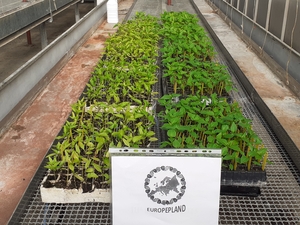
In this period, activities have focused on the establishment of the core collection. To date, over 430 landrace accessions have been provided by participating genebanks and research institutions. The collection represents the diversity of 12 European countries across the Mediterranean basin and the Balkans, from both coastal and inland regions. Furthermore, it encloses a wide range of variation in terms of fruit shape and size, colour and pungency degree. DNA isolation has already started, with the aim of performing SNP genotyping to infer genetic diversity and define population structure. These data will be linked to other European projects and will be implemented with phenotypic information.
October 2024
The kick-off meeting of the EuroPepLand Activity was held jointly with the EVA Pepper network annual meeting from 30-31 October in Almeria, Spain.
Summary of the meeting | Report | Presentations
Presentations of the EuroPepLand kick-off meeting
30-31 October 2024, Almeria, Spain
| Title | Author |
| Welcome to Almeria (462,8 KB) | Semillas Fito |
| Introduction to EuroPepLand (2,0 MB) | P. Tripodi |
| EuroPepLand work planning (1,8 MB) | P. Tripodi |
| Presentation of collections | |
| Armenia (1,9 MB) | K. Sarikyan |
| Bulgaria (2,3 MB) | V. Masheva |
| Czech Republic (2,4 MB) | H. Stavelikova |
| France (1,3 MB) | M. Bouët, V. Lefebvre |
| Germany (2,2 MB) | U. Lohwasser |
| Greece (737,8 KB) | I. Mellidou |
| Italy (1,3 MB) | R. Giunta |
| Netherlands (956,7 KB) | W. van Dooijeweert |
| North Macedonia (7,7 MB) | S. Ivanovska |
| Romania (3,3 MB) | A. Antal |
| Serbia (4,9 MB) | D. Danojević |
| Spain (3,6 MB) | A. Rodríguez Burruezo |